
8 Ways to Improve Your Espresso
Discover 8 easy but powerful ways to improve your espresso at home, fix common mistakes, and finally pull shots that taste like they came from a professional barista.
Taylor
5/6/20267 min read
It's hard for me to say which one of these is the most important so instead I will split these up into two groups. The paramount group which are absolutely essential for a brilliant shot and the hidden gems that unexpectedly increased the quality of my shots and enough for me to see a noticeable difference.
Paramount Group: 1-5
Hidden Gem Group: 6-8
1. Freshly Roasted Beans
There's no way around it. There's no way to sugar coat it. If you want a good and healthy, well balanced shot of espresso you must have fresh beans.
By "fresh" I simply mean beans that have been roasted about 2 weeks before use. This is when the flavors in coffee beans start to open up and flourish due to the degassing that happens over the course of those 2 weeks. The beans come to life and make not only your espresso but your final drink rich with flavor.
The crema will be thicker as well which some people prefer for a more full-bodied feel in their drink. Not to mention it's GREAT for latte art.
Many people ask me where to find fresh beans, which is reasonable if you've never really thought of it before. Here is the best rule. Stay away from grocery stores.
It's best to go straight to a roaster. But even if you can't go to a roaster, any local coffee shop near you will almost certainly carry some whole beans that you can buy from them and many times you can check the roast date on the bag. If it's a coffee shop that knows what it's doing then the beans will be fresh, regardless of who roasted them.
My favorite beans are from CoffeeBros who I have partnered with to get the best coffee to the masses. Check out my premium coffee pages here.
2. A Quality Burr Grinder
Not all burr grinders are the same unfortunately. They can be made with different types of metals, or have 5 points or 6 points. They can have additional groves on the burr itself to allow even further grinding capability, etc.
There are options.
Nearly all of them can get you close to espresso fine grind size however there are some brands and makes which will explicitly say "not for espresso" or vice versa. So you do have to sort of be careful and avoid buying something off the shelf without researching its capability.
My original TIMEMORE grinder couldn't grind down to espresso for example, but that was an older model and the newer ones like the TIMEMORE Chestnut S3 (see on Amazon) can grind down to espresso no problem.
The reason this matters at all is because you can't get an even extraction if your coffee grounds aren't even and uniform from particle to particle. You want them all to be the exact same size, and you want them to be small...like really small. The smaller the coffee particles the more total surface area there is across the grounds. With more surface area comes higher extraction, which is what you want in espresso. The water is only interacting with the coffee for mere seconds so you want as much extraction as possible within those short seconds. You also need the coffee to be small enough to be packed tight together in the portafilter, allowing pressure to build to 9 bars in the espresso machine.
Only a high quality burr grinder is going to be able to pull off both consistency and size.
3. An Accurate Scale
This might seem obvious, but if you don’t know exactly how much coffee you’re using, you can’t truly dial in your shots. And if you can’t dial in your shots, you won’t be able to diagnose or fix what’s going wrong. While a scale doesn’t change the coffee grounds themselves, it absolutely impacts your final espresso.
I used to have a scale that would jump up or down by a few grams every time I tried to measure out 18g. I’d either have to start over or just trust the reading; but if I’m trying to be precise, that’s not something I can rely on.
The reason this matters is simple: small inaccuracies can throw everything off. If you think you’re using 18g but it’s actually 21g, your shot will take much longer to pull and likely taste overly bitter. On the other hand, if your “18g” is really closer to 15g, the water will flow through too quickly, resulting in a weak, under-extracted shot that tastes sour.
I have listed my favorite scales here if you want to read up on them. I personally am a little partial to TIMEMORE.
4. A WDT (And Leveler)
This might be the most fun tools out of the whole process, let me explain:
A WDT (Weiss Distribution Technique) tool is designed to break up clumps in freshly ground coffee and evenly redistribute the grounds within the portafilter basket. When coffee grounds are clumped or unevenly distributed, water under pressure will naturally find the path of least resistance, leading to channeling—where certain areas of the puck are over-extracted while others remain under-extracted. By using thin needles to gently stir and separate the grounds, a WDT tool creates a more homogeneous coffee bed with consistent density throughout. This uniformity allows water to flow evenly across the entire puck during extraction, resulting in a more balanced shot with improved clarity, sweetness, and overall consistency.
A coffee leveler (or distributor) further refines this process by ensuring the surface of the coffee bed is flat and evenly compressed before tamping. After WDT breaks up clumps and distributes the grounds internally, the leveler smooths the top layer, eliminating high or low spots that could cause uneven pressure during tamping. This step helps create a puck with consistent resistance from edge to edge, which is critical for even water flow. Together, WDT and leveling work in tandem to produce a uniform puck structure, significantly reducing the risk of channeling and leading to a more controlled, repeatable extraction.
These will take your espresso to a whole new level!
5. An Espresso Machine Capable of 9 Bars
Believe it or not, the number of appropriate bars for espresso (9) isn't arbitrary. It’s the pressure at which espresso machines have been engineered to consistently deliver the ideal flow rate and extraction yield for most coffees. This pressure allows for proper emulsification of coffee oils, which contributes to the rich crema and mouthfeel that define espresso.
Yes, of course there are variations above or below 9 bars which can be used intentionally to highlight certain characteristics, but 9 bars remains the standard because it reliably produces a well-rounded, high-quality shot.
At 9 bars of pressure, hot water is forced through a tightly packed puck of finely ground coffee at a rate that promotes optimal extraction of soluble compounds—oils, sugars, acids, and aromatics—without overemphasizing bitterness or astringency. The result is a shot with proper body, crema formation, and a balanced flavor profile. If the pressure is too low, the water may pass through too slowly or unevenly, leading to under-extraction and a sour, thin shot. Too high, and it can over-extract the coffee, producing harsh, bitter notes and an unpleasant finish.
Having an espresso machine that can truly get you to 9 bars is important. And for this reason I will never get behind the idea that an Aeropress can produce true espresso. It simply can't.
6. A Bottomless Portafilter
This one was probably the least expected and it might be a hot take but in my experience I've found it to be true. I should also say that this is strictly in the context of needing a good base for latte art.
I had been using a portafilter with a bottom which splits the output into two, so that naturally you can make two drinks at once. Very useful, indeed!
The problem? It was splitting my crema in two.
Wait, isn't that the point? Yes it is. But it was also thinning out my crema by stretching it over two areas rather than one. With the crema stretched out I couldn't get a proper base. And even if I managed to get a decent base the contrast between the coffee and milk wasn't anywhere close to what I wanted.
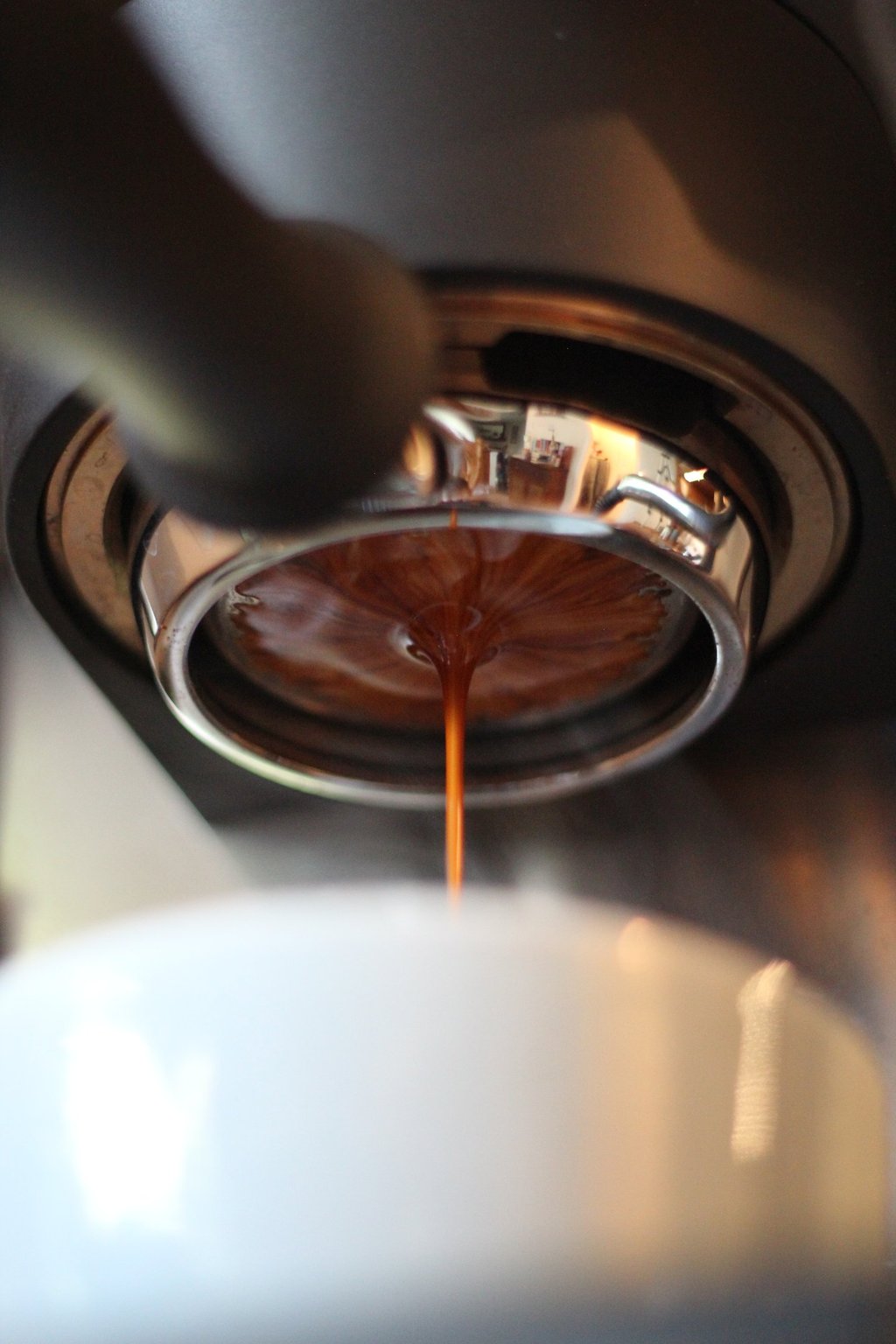
The bottomless portafilter fixed this. As you can see in the image at the top of this blog the bottomless portafilter allows the espresso to come out of one place. No stretching, no thinning. It's allowed me to retain a certain thickness of my crema which in turn allows for better latte art.
7. A Cup With A Rounded (Pointed) Bottom
It's intuitive really but I simply never thought about it.
Here's what's happening with flat bottom cups. The espresso gets pulled and ends up at the bottom of your cups spread out over a wide surface, thinning it's crema, and more importantly, losing it's heat. Nobody wants a cold, stale espresso shot.
The rounded bottom preserves the crema, avoiding it from "breaking", and allows for the heat to actually stay in the espresso.
As an added bonus the rounded and pointer bottoms allow the aromaticity to remain potent, according to some baristas. Whether that's true or not doesn't really matter much to me, either way the rounded bottoms can't be a bad thing. My favorite cups are the latte mugs from Loveramics (see on Amazon).
8. Avoid Transfer of Shot
Similar to number 6, I found that transferring my shots from a shot glass to a mug thinned out my crema, and just like the carbonation fizzles out from soda so does the crema with coffee; once it's gone, it's gone.
So now every time I pull a shot I pull it right into the cup, even if I am making two drinks I will set two cups under the group head (on a scale of course, I'm not a barbarian). This teeny tiny adjustment has allowed me to retain much more of the crema, which is great if you like a fuller-bodied experience or want to pour some siiick latte art.
Conclusion
In the end, great espresso is about controlling the variables that matter most. When you combine fresh beans, precise grinding, accurate dosing, and proper pressure with small but intentional upgrades like a bottomless portafilter or even the right cup, everything starts to come together.
What surprised me most through all of this is how much the little things actually matter. Espresso is a game of details, and once you start paying attention to them, you’ll notice the difference immediately—not just in taste, but in texture, crema, and overall experience.
-Taylor