The Maillard Reaction Explained: The Chemistry That Makes Coffee Taste Like Coffee
Part 1: Introduction, what the Maillard reaction is, reaction chemistry, electron movement, activation energy, and temperature.
Taylor
7/8/20268 min read

Note From The Author
With the Maillard Reaction being an important part of the chemistry happening in coffee roasting (and with me being a biotechnologist who has a keen affinity to organic chemistry) it seemed only fitting that I write an article about what's all happening during that process. I anticipated this to be like any other article I've written in the past. Around 700 words and easy to read.
But then I really started to get into the chemistry and realized that not only does it get more complicated than I anticipated but there are also many scientific terms and concepts that I need to explain if I am going to do this correctly.
So this one article idea turned into a 4 part series.
This is going to be for the nerds out there. I am honestly expecting like 1 or 2 people to actually read through everything. That's okay. If even 1 person gets a benefit from this series then my work is justified.
Lastly, I do want to be up front here. I did fact check some of this information with AI. Even though my organic chemistry education has mostly retained from college it's also been several years, and I didn't want to put anything in this series that was incorrect. Thank you for understanding. With that, let's get nerdy.
What is the Maillard Reaction?
The Short Answer
The Maillard reaction is a network of thousands of chemical reactions between amino acids and reducing sugars that occurs when food is heated. In coffee roasting, it is responsible for producing most of the compounds associated with sweetness, roasted nuts, chocolate, bread, caramel, and countless other aromas. Despite often being referred to as a single reaction, the Maillard reaction is actually an interconnected series of molecular transformations involving electron redistribution, bond formation, molecular rearrangements, and polymerization. It has no single activation energy, no precise starting temperature, and no single endpoint. Instead, it is a dynamic chemical system whose products evolve continuously as temperature, time, moisture, and the composition of the coffee bean change throughout roasting.
Why the Maillard Reaction Matters in Coffee
Take a raw green coffee bean and chew on it. It's dense, grassy, slightly bitter, and vaguely reminiscent of fresh peas or hay. There is almost none of the aroma we associate with coffee.
Now compare that to a freshly roasted bean. Chocolate. Toasted almonds. Brown sugar. Hazelnut. Fresh bread. Molasses. Caramel. Floral notes. Fruit. Smoke.
Why such a difference? Well, chemistry. (Thanks captain obvious).
While several chemical processes contribute to roasting, including caramelization, pyrolysis, lipid oxidation, and thermal degradation, the Maillard reaction is the primary engine responsible for transforming hundreds of relatively simple molecules inside a green coffee bean into hundreds—possibly thousands—of new flavor and aroma compounds.
For coffee roasters, understanding the Maillard reaction is more than an academic exercise. Every decision made during a roast—heat application, airflow, drum speed, development time, and rate of rise—influences how these reactions unfold. The flavor in your cup is ultimately the result of chemistry unfolding in real time.
But before we can understand roasting, we first need to understand what is happening at the molecular level.
What Exactly Is the Maillard Reaction?
The Maillard reaction was first described in 1912 by French physician and chemist Louis-Camille Maillard, who was studying reactions between amino acids and sugars under physiological conditions.
His original goal had nothing to do with coffee. He was investigating protein synthesis. Instead, he discovered one of the most important reactions in food chemistry.
Today, food scientists generally define the Maillard reaction as:
A complex network of non-enzymatic chemical reactions between amino compounds (primarily amino acids and proteins) and reducing sugars that produces hundreds of intermediate compounds and eventually brown nitrogen-containing polymers known as melanoidins.
Notice something important. The definition doesn't say "the reaction." It says a network of reactions.
That distinction matters because every coffee bean contains dozens of amino acids and multiple reducing sugars. Every one of these molecules can react differently depending on temperature, water availability, pH, and surrounding compounds.
Instead of one pathway, imagine an enormous highway system with thousands of possible exits.
The Ingredients Already Exist Inside Green Coffee
Unlike many industrial chemical reactions, nothing needs to be added during roasting. Green coffee already contains nearly everything required.
Among the most important reactants are:
Reactant Role in the Maillard Reaction
Glucose Reducing sugar
Fructose Reducing sugar
Arabinose Pentose sugar
Amino acids Nitrogen source
Peptides Additional amino groups
Proteins Reservoir of amino acids
Coffee also contains sucrose, which technically is not a reducing sugar.
However, as roasting progresses, sucrose begins to decompose into glucose and fructose, effectively feeding additional reactants into the Maillard reaction.
In other words, the bean carries both the fuel and the building blocks before roasting even begins.
Heat simply starts the process.
Why Do Sugars and Amino Acids React?
To answer that, we need to zoom in to the level of atoms and electrons.
Every chemical bond is formed by electrons.
The Maillard reaction begins because certain atoms inside reducing sugars possess an uneven distribution of electron density.
A reducing sugar contains a carbonyl group, which consists of a carbon atom double-bonded to an oxygen atom (C=O).
Oxygen is much more electronegative than carbon, meaning it has more valence electrons in its natural state.
This also means oxygen pulls any shared electrons toward itself.
As a result:
Oxygen develops a partial negative charge (δ⁻).
The carbon atom develops a partial positive charge (δ⁺).
That carbon atom is now electron-deficient.
Chemists call it an electrophile, meaning it seeks additional electron density.
Now consider an amino acid.
Its amino group (-NH₂) contains a nitrogen atom with a lone pair of electrons that are not participating in any bond.
These electrons are relatively available for reaction.
This makes the amino group a nucleophile—a molecule that donates electrons.
Like opposite poles of magnets, electrophiles and nucleophiles naturally tend to react.
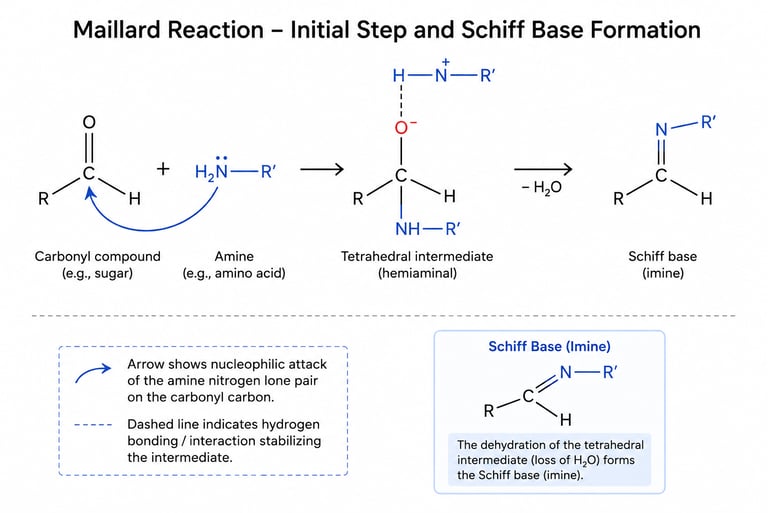
I made sure to include a picture below, seeing it visually really helps.
What Happens During the First Molecular Collision?
When enough thermal energy is available, molecules begin colliding more frequently and with greater force. Most collisions accomplish nothing. The molecules simply bounce apart...booooorring...
But occasionally, a collision occurs with the correct orientation and sufficient energy.
At that moment, the lone pair of electrons on the nitrogen atom attacks the electrophilic carbon of the sugar's carbonyl group.
This is called a nucleophilic addition reaction.
No atom consciously "moves." Instead, electrons are redistributed. Existing chemical bonds weaken while new ones begin forming.
The carbon-oxygen double bond temporarily opens as electrons shift toward the oxygen atom, allowing a new carbon-nitrogen bond to form.
This unstable intermediate quickly undergoes several proton transfers before eventually forming what chemists call a Schiff base.
That Schiff base represents the first major milestone of the Maillard reaction. The Schiff base is relatively unstable and in organic chemistry when you have unstable molecules, you have highly reactive molecules. They react really easily with other things.
Rather than following one predictable route, the molecule can undergo rearrangements, fragmentation, dehydration, oxidation, cyclization, or reactions with entirely different molecules.
By the time roasting is complete, the original sugar may no longer resemble anything it started as.
Does the Maillard Reaction Have a Specific Activation Energy?
This is one of the biggest misconceptions in both cooking and coffee roasting.
The short answer is no.
There is not one activation energy for "the Maillard reaction."
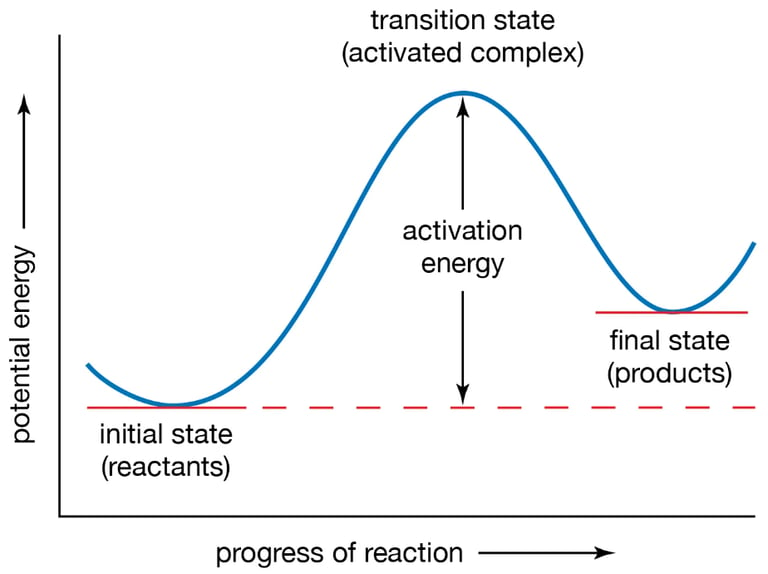
Activation energy (Ea) is the minimum energy required for reactants to reach the transition state—the unstable, high-energy arrangement of atoms where old bonds are breaking and new bonds are forming. Only molecules with enough energy to overcome this barrier can proceed to products.
For a simple reaction, such as the decomposition of hydrogen peroxide, assigning a single activation energy is straightforward because there is one dominant pathway.
The Maillard reaction is fundamentally different.
It is not one reaction but a network of thousands of reactions, each involving different reactants, intermediates, and products. Every elementary step has its own activation energy.
For example:
The initial formation of a Schiff base has one activation energy.
The Amadori rearrangement has another.
Strecker degradation has yet another.
Melanoidin polymerization proceeds through multiple steps, each with its own energy barrier.
Researchers have measured activation energies for individual Maillard reactions ranging from roughly 30 kJ/mol to well over 150 kJ/mol, depending on the specific sugar, amino acid, water activity, pH, and reaction being studied. That wide range reflects the diversity of the chemistry rather than inconsistency in the measurements.
This is also why changing the composition of a coffee bean—through variety, processing method, or origin—can noticeably alter roasting behavior. Different beans contain different concentrations of amino acids and sugars, shifting which reaction pathways dominate and how readily they proceed.
Temperature Doesn't "Turn On" the Maillard Reaction
A common statement in coffee literature is that "the Maillard reaction begins around 140°C (284°F)."
It's a useful rule of thumb, but it's not chemically precise.
From a kinetic perspective, the Maillard reaction can occur at much lower temperatures. In fact, it proceeds slowly at room temperature. That's why powdered milk, dried pasta, breakfast cereals, and stored foods gradually brown over months or years.
What changes during coffee roasting is the reaction rate.
As temperature increases, molecular motion accelerates. Collisions become more frequent, and a larger fraction of molecules possess enough energy to overcome their activation barriers. According to the Arrhenius equation, even a modest increase in temperature can produce a substantial increase in reaction rate.
In practical roasting terms:
Below about 120°C (248°F): Maillard chemistry is present but extremely slow.
Approximately 140–170°C (284–338°F): Reaction rates increase rapidly as the bean dries and reactants become more concentrated.
Above roughly 170°C (338°F): Multiple Maillard pathways proceed simultaneously, producing many of the compounds associated with sweetness, nuttiness, toasted bread, and roasted coffee.
There is no molecular switch that flips at exactly 140°C. Instead, the reaction gradually accelerates as thermal energy accumulates and the bean's internal environment becomes more favorable for complex chemistry.
Conclusion to Part 1:
The Maillard reaction may sound like a single chemical reaction, but it's actually a vast network of thousands of interconnected reactions that begin when reducing sugars and amino acids are heated together. In coffee roasting, these reactions are responsible for transforming a raw, grassy green bean into one rich with sweetness, complexity, and aroma.
Key takeaways:
The Maillard reaction begins when amino acids react with reducing sugars.
It starts because electron-rich amino groups are attracted to electron-deficient carbonyl groups in sugars, allowing new chemical bonds to form.
The first major product is a Schiff base, which serves as the starting point for many additional reactions.
There is no single "Maillard reaction" or single activation energy—it's a network of thousands of individual reactions, each with its own chemistry.
The reaction doesn't suddenly start at one specific temperature. Instead, it gradually accelerates as heat increases and conditions inside the coffee bean become more favorable.
Understanding these molecular processes helps explain why roast temperature, time, and bean composition have such a profound effect on the flavor of the final cup.
In Part 2, we'll follow the reaction beyond the initial electron transfer, exploring the formation of Schiff bases, the Amadori rearrangement, Strecker degradation, and the creation of melanoidins—the large brown polymers that give roasted coffee much of its color, body, and complexity. We'll also examine how these pathways generate hundreds of volatile aroma compounds that define the sensory character of coffee.
References:
Belitz, H.-D., Grosch, W., & Schieberle, P. Food Chemistry. 4th ed. Springer.
Martins, S. I. F. S., Jongen, W. M. F., & van Boekel, M. A. J. S. (2000). A review of Maillard reaction in food and implications to kinetic modelling. Trends in Food Science & Technology, 11(9–10), 364–373.
Nursten, H. E. (2005). The Maillard Reaction: Chemistry, Biochemistry and Implications. Royal Society of Chemistry.
Illy, A., & Viani, R. (Eds.). (2005). Espresso Coffee: The Science of Quality. 2nd ed. Elsevier Academic Press.
Flament, I. (2002). Coffee Flavor Chemistry. John Wiley & Sons.
Clarke, R. J., & Macrae, R. (Eds.). (1985–1988). Coffee (Volumes 1–6). Elsevier Applied Science.
Van Boekel, M. A. J. S. (2006). Formation of flavour compounds in the Maillard reaction. Biotechnology Advances, 24(2), 230–233.
Specialty Coffee Association (SCA). Coffee roasting research and educational resources: https://sca.coffee