The Maillard Reaction Explained: The Chemistry That Makes Coffee Taste Like Coffee
Part 2: From Schiff Bases to Melanoidins — How Simple Molecules Become Coffee Flavor
Taylor
7/15/20269 min read

In Part 1, we followed the very first step of the Maillard reaction network. A reducing sugar collided with an amino acid, the nitrogen atom donated its lone pair of electrons to the sugar's electrophilic carbonyl carbon, and a new carbon–nitrogen bond formed.
That first reaction produced what chemists call a Schiff base.
If this were a simple chemical reaction, we could stop there.
But this is the Maillard reaction we are talking about...
That Schiff base is only the beginning.
Once it forms, the chemistry branches into an astonishing web of competing pathways. Molecules rearrange themselves, lose water, split apart, react with oxygen, combine with neighboring compounds, and eventually assemble into large brown polymers called melanoidins. Along the way, hundreds of volatile aroma molecules are produced—the compounds that make roasted coffee smell like roasted coffee.
Remember, there isn't a single roadmap in this reaction. It's more like a city with thousands of intersections, where every molecule can take a slightly different route depending on temperature, moisture, pH, pressure, and the compounds surrounding it.
The Schiff Base Is a Temporary Structure
Although the Schiff base is often presented as the "first product" of the Maillard reaction, it's actually a relatively unstable intermediate. Chemically, it contains a carbon–nitrogen double bond (C=N), also known as an imine bond, which is considerably more reactive than many of the stable carbon-carbon bonds found in organic molecules.
Why is it so reactive?
The answer lies in electron distribution. Nitrogen is more electronegative than carbon, so it pulls the shared electrons toward itself. This creates an uneven distribution of electron density across the bond, polarizing the molecule and making nearby atoms more susceptible to further chemical transformations.
At roasting temperatures, molecules possess significant vibrational energy. Every bond is constantly stretching, compressing, and twisting as atoms vibrate in response to heat. Those vibrations make certain rearrangements energetically favorable, so rather than remaining a Schiff base for very long, the molecule quickly undergoes one of the most important transformations in food chemistry.
The Amadori Rearrangement
The next major step is called the Amadori rearrangement, named after Italian chemist Mario Amadori, who first described the process in the 1920s.
This isn't simply a case of atoms swapping positions. Instead, it involves a coordinated redistribution of electrons and hydrogen atoms throughout the molecule. Several proton transfers occur, double bonds shift, and single bonds become double bonds while others move elsewhere in the molecular framework. Although the carbon backbone remains largely intact, the electronic structure changes dramatically.
If you could somehow slow time enough to observe the process—which isn't physically possible—you would see electrons continuously shifting between atomic orbitals as the molecule searches for a more stable arrangement. Nature generally favors lower-energy configurations, and the Amadori product represents a thermodynamically more stable state than the original Schiff base.
It's important not to confuse stable with unreactive.
The newly formed Amadori compound still contains several chemically active functional groups capable of participating in dozens of additional reactions. Rather than being the end of the Maillard reaction, it serves as a major branching point where the chemistry begins to diversify.
Think of it less as the destination and more as a busy railway station where thousands of different journeys begin.
Why Rearrangements Happen at All
A reasonable question is why the molecule doesn't simply remain in its original configuration.
The answer comes down to energy.
Every molecule exists within what chemists call a potential energy landscape. Some arrangements of atoms resemble a marble balanced on top of a hill—possible, but unstable. Others resemble a marble resting comfortably in a valley, where much less energy is stored. Chemical systems naturally tend toward these lower-energy states whenever an accessible pathway exists.
The Amadori rearrangement effectively allows the molecule to "roll downhill" into one of these more stable configurations.
Whether that happens depends on two closely related concepts: thermodynamics and kinetics. Thermodynamics determines whether the final state is energetically favorable, while kinetics determines how quickly the pathway can actually be reached. Temperature influences both by supplying molecules with enough energy to overcome activation barriers while simultaneously increasing the frequency of successful molecular collisions.
An Amadori product rarely follows one predictable pathway. Instead, it may undergo dehydration (loss of water), fragmentation into smaller molecules, oxidation, reduction, cyclization to form ring structures, isomerization, condensation reactions, or polymerization. Each of these pathways produces entirely new compounds with their own unique chemical properties.
Those newly formed compounds don't simply remain unchanged. They become reactants themselves, participating in additional reactions that create still more molecules. What began as a single sugar reacting with a single amino acid quickly expands into an intricate web of interconnected chemistry.
Imagine a tree. The Schiff base forms the trunk, the Amadori rearrangement creates the first major branches, and every subsequent reaction produces smaller branches, twigs, and leaves. By the end of roasting, thousands of unique molecular species may exist simultaneously inside a single coffee bean.
Water Is Both Friend and Enemy
One of the more surprising aspects of the Maillard reaction is the role water plays. People often assume that increasing the temperature automatically accelerates the reaction, but water activity is just as important.
Water activity isn't the same as moisture content. Instead, it describes how much water is chemically available to participate in reactions.
If too much free water is present, sugars and amino acids become diluted, reducing the frequency with which they collide. The reaction slows because the reactants are effectively spread farther apart.
At the opposite extreme, if nearly all of the water disappears, the reaction also slows. Molecules lose mobility and become trapped inside increasingly rigid structures, making it more difficult for them to encounter one another.
As a result, the Maillard reaction actually proceeds fastest at intermediate water activities, where molecules are concentrated enough to collide frequently while still remaining mobile.
This is one reason coffee roasting is such a dynamic process. During the early drying phase, the bean contains enough moisture that reaction rates remain relatively modest. As water evaporates, reactant concentrations increase and conditions become ideal for rapid Maillard chemistry. Later in the roast, continued moisture loss begins limiting molecular mobility again, while much higher temperatures introduce entirely different reactions, such as pyrolysis.
The bean is constantly changing the environment in which its own chemistry occurs.
Strecker Degradation: Where Many Coffee Aromas Begin
If there is one stage of the Maillard reaction that coffee professionals should understand, it's Strecker degradation.
This pathway is responsible for producing many of the aroma molecules that define roasted coffee.
The process begins when highly reactive α-dicarbonyl compounds, which were formed earlier in the Maillard reaction, encounter amino acids. Rather than simply combining with them, these compounds initiate a series of reactions that remove the amino group and release one carbon atom as carbon dioxide. The remaining molecular framework rearranges into a new compound known as a Strecker aldehyde.
These aldehydes have remarkably low odor thresholds, meaning that even tiny concentrations can have a profound impact on aroma.
Some common examples include:
| Strecker Aldehyde | Typical Aroma |
| Methional | Cooked potato |
| Phenylacetaldehyde | Honey, floral |
| 2-Methylpropanal | Malty |
| 3-Methylbutanal | Chocolate, malt |
| Benzaldehyde | Almond, cherry |
Many of these compounds are present in roasted coffee. Individually they may not smell distinctly like coffee, but together they contribute to the remarkably layered aroma profile that our brains instantly recognize. I personally think it' the best smell on Earth. No like actually, there isn't a single other olfactory experience I enjoy more than the smell of fresh coffee.
Heterocyclic Compounds: Coffee's Aromatic Powerhouses
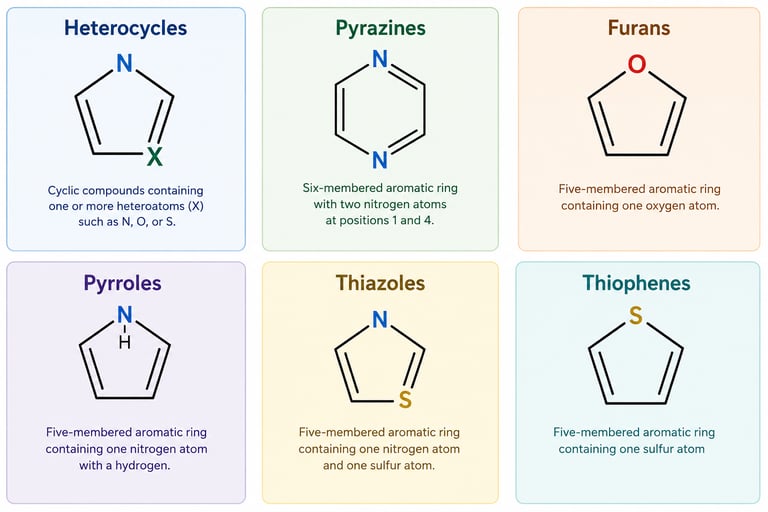
As roasting continues, entirely new classes of molecules begin to appear. Many of these contain ring-shaped structures known as heterocycles, in which atoms such as nitrogen, oxygen, or sulfur replace one or more carbon atoms within the ring.
These seemingly small changes have a major impact on electron distribution throughout the molecule, altering how it interacts with the olfactory receptors in our noses.
Some of the most important families include (see image below):
Pyrazines
Pyrazines are among the signature compounds of roasted coffee and are commonly associated with aromas of roasted peanuts, cocoa, toasted bread, and hazelnuts. Many can be detected at concentrations as low as parts per billion, making them disproportionately important contributors to coffee aroma.
Furans
Furans typically contribute sweet, caramel-like aromas reminiscent of maple syrup, baked sugar, and toasted desserts. Many originate from the degradation of sugars during the Maillard reaction before overlapping with caramelization chemistry later in the roast.
Pyrroles
Pyrroles are commonly associated with toasted grain, bread crust, earthy notes, and warm roasted flavors that add depth and complexity to coffee.
Thiazoles and Thiophenes
Sulfur-containing compounds such as thiazoles and thiophenes often exist in extremely small concentrations, yet they possess remarkably intense aromas. These molecules contribute savory, nutty, roasted characteristics that help round out the overall flavor profile.
Why Coffee Produces Hundreds of Aromas Instead of One
A green coffee bean is chemically more complex than many people realize.
It contains dozens of amino acids, multiple reducing sugars, proteins, chlorogenic acids, lipids, organic acids, minerals, and countless trace compounds. Every one of these molecules influences the chemistry taking place during roasting.
Different amino acids generate different aroma compounds. Different sugars produce different intermediates, and different temperatures favor different reaction pathways. Even neighboring regions within the same bean may experience slightly different temperatures, moisture levels, and reactant concentrations.
As a result, every microscopic region of the bean behaves like its own miniature chemical reactor.
By the end of roasting, scientists have identified well over 1,000 volatile compounds in roasted coffee. Not all are generated directly through the Maillard reaction, but the Maillard reaction provides the foundation upon which most of coffee's characteristic aromas are built.
The Beginning of Browning: Melanoidins
Eventually, many of the intermediate molecules stop breaking apart and begin reacting with one another instead.
Small molecules combine into larger ones. Those larger molecules continue reacting until enormous molecular networks begin forming. These high-molecular-weight polymers are collectively known as melanoidins, and they are largely responsible for the deep brown color of roasted coffee.
Interestingly, chemists still cannot describe the precise structure of every melanoidin.
Unlike caffeine or glucose, melanoidins are not one specific molecule. Instead, they represent an enormous family of nitrogen-containing polymers formed through countless condensation and polymerization reactions occurring simultaneously during roasting.
So why do they appear brown?
The answer once again comes back to electron behavior.
As these molecules grow larger, they develop extended conjugated systems, in which alternating single and double bonds allow electrons to become delocalized across many atoms. Rather than remaining confined between two atoms, these electrons are shared over much larger regions of the molecule.
This changes how the molecule interacts with visible light.
Instead of reflecting all wavelengths equally, melanoidins absorb specific portions of the visible spectrum while reflecting others. The reflected wavelengths appear brown to the human eye.
The familiar color of roasted coffee is therefore not simply the result of something being "burned." It is the visible consequence of increasingly complex electron systems developing inside large polymeric molecules.
In a very real sense, the color of roasted coffee is an expression of molecular quantum mechanics.
Part 2 Summary
By this point, the simple reaction between a sugar and an amino acid has evolved into an incredibly complex network of chemical pathways. These reactions generate many of the aroma compounds, flavor precursors, and brown pigments that make roasted coffee so distinctive.
Key takeaways:
The Schiff base is only a temporary intermediate before the chemistry rapidly becomes more complex.
The Amadori rearrangement creates a more stable molecule that serves as a branching point for thousands of additional reactions.
Water activity plays a critical role—both too much and too little water can slow the Maillard reaction.
Strecker degradation produces many of the aldehydes responsible for roasted, malty, floral, and chocolate-like aromas.
Heterocyclic compounds such as pyrazines, furans, pyrroles, and thiazoles contribute many of coffee's signature flavors and aromas.
As molecules continue reacting, they eventually form melanoidins—large nitrogen-containing polymers that give roasted coffee its characteristic brown color and contribute to body and mouthfeel.
In Part 3, we'll leave the laboratory behind and step into the roasting drum, following these chemical reactions through each stage of the roast—from drying and yellowing to first crack and development—and see how roasters manipulate them to shape the flavor in the cup.
References
Belitz, H.-D., Grosch, W., & Schieberle, P. Food Chemistry. 4th ed. Springer.
Nursten, H. E. (2005). The Maillard Reaction: Chemistry, Biochemistry and Implications. Royal Society of Chemistry.
Martins, S. I. F. S., Jongen, W. M. F., & van Boekel, M. A. J. S. (2000). A review of Maillard reaction in food and implications to kinetic modelling. Trends in Food Science & Technology, 11(9–10), 364–373.
Flament, I. (2002). Coffee Flavor Chemistry. John Wiley & Sons.
Illy, A., & Viani, R. (Eds.). (2005). Espresso Coffee: The Science of Quality. 2nd ed. Elsevier Academic Press.
Clarke, R. J., & Macrae, R. (Eds.). (1985–1988). Coffee (Volumes 1–6). Elsevier Applied Science.
Whitfield, F. B. (1992). Volatiles from interactions of Maillard reactions and lipids. Critical Reviews in Food Science and Nutrition, 31(1–2), 1–58.
Yaylayan, V. A. (2003). Recent advances in the chemistry of Strecker degradation and Amadori rearrangement. Food Science and Technology Research, 9(1), 1–6.